[Cold open | camera on | slight smile]
Okay. Imagine this: my undergrad life restarts. Like… I respawn as a freshman again. Same brain, same hunger, but zero research opportunities, zero "connections," zero insider information. Just me, a campus, and that feeling of "I want to do real research, but how do people even get in?"
This vlog is basically my cheat-code. Not the fake kind. The real kind. The kind that costs time, effort, and a slightly unhinged level of seriousness.
"Long-termism."
Not "work hard for two weeks."
I mean: build a life where every step quietly stacks into the next one.
Chapter 1: If Two Things Can Be Done Together, Do Them Together
When you're young—like really young in your career—time is your biggest advantage. But only if you use it like a strategist.
So here's my first rule:
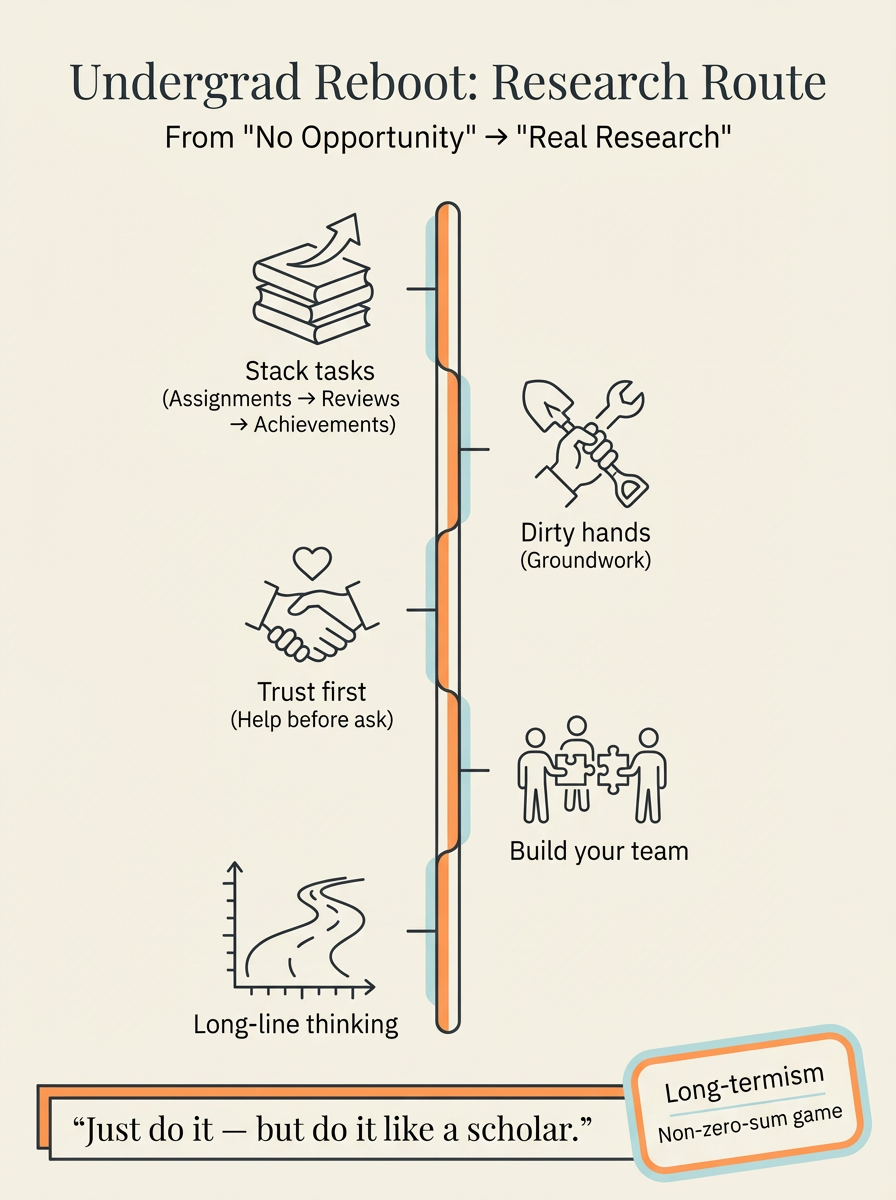
"If you find a few things can be done together, you do them together."
Example: you have a course assignment. Most people treat it as "get it done."
If I restart? I treat it as: this could be a literature review.
So I would take that course paper and develop it into a real literature review, with depth. And I would not be trapped by the course rubric, because the rubric treats you like a student.
But if you want to become a scholar, then:
"Please become a scholar now."
Do the assignment like it's going to be published. Not because it will be published, but because you're training your standards.
Chapter 2: "Learn by Dirty Hands"
Here's another rule I'd keep:
"Learn by dirty hands. Do groundwork."
Meaning: in every assignment, every project, every task—know exactly what you're doing. Don't outsource your thinking.
Not to your teammate.
Not to your future RA.
Not to AI.
(And yes I use AI a lot—if you want that workflow, go check my other post. But I'm serious: AI can help, but it can't replace your internal pathway.)
Because the thing people don't tell you is: Aha moments need time. Humans are amazing because we pause, we breathe, we get stuck, then our brain slowly gets shaped.
"That confidence becomes your internal engine."
I can figure it out. I didn't know before, and I learned it. I can learn the next thing too.
Chapter 3: Make Your Coursework Turn Into Research Experience
This part is the biggest hack that doesn't feel like a hack.
Sometimes "doing research" and "doing undergrad coursework" can literally be the same thing.
Let me give you a real example from my life:
In undergrad I took a class called psychological assessment. The assignment was to develop or translate a scale. Most people did the minimum.
Me? I did it step by step, seriously. Like I was building something real. I thought through each procedure carefully. I tried to make it "publication-ready."
And because I did the steps properly, later it actually became a real outcome: I collaborated with the professor, we developed it further, and we submitted it as a poster.
"Professors don't trust a student to do research just because the student says 'I'm interested.'"
They trust you when your work shows: you're serious, you can execute, you already solved 80% of the problems, and the professor only needs to solve the last 20%.
Chapter 4: "Just Do It" Is Not Brain-Dead
I always say: just do it.
It sounds simple, but it's not mindless.
It means: treat each thing like it matters. Like it's the last thing you'll do. Like it deserves your full attention.
And over time, something crazy happens:
All the pain you went through—learning each tool, figuring out each step, doing each boring part—starts paying you back.
Chapter 5: Build Relationships Like a Human
Now the second big line of long-termism:
"Build your own team. Build good relationships."
Here's the truth: when you're a student, you're a nobody. People won't immediately trust you with "real research."
So how do you get trust?
You walk into their world first. You help. You support what they need. You start from the other person's perspective.
That's not manipulation. That's honestly just… altruism. And I still believe research and helping others can be one thing.
In my junior year, I was a TA for a professor. I told them:
"I want to go do real field work with an NGO. I can volunteer. I can help with anything."
At first, nobody is going to give you an experiment. Of course. So I started with what is realistic: archived data. I did it well. I delivered. I made myself useful.
"People invest in you after they trust you."
And trust is built through time, care, and real contribution.
Chapter 6: Build Your Own Team
Another thing I did, especially later:
I started building my own team.
At first in undergrad, I was often "a team member." I learned work ethic and workflow from strong teams. Then later—especially in my gap year—I started becoming a project leader.
And honestly, I built this habit early:
When I had group work, I chose people who were good to work with. People who could learn together, give each other feedback, and grow.
I never treated teammates as competitors.
If I knew something, I would teach it. I would share tricks, software tips, search strategies—because: People power is real.
I did this with my senior thesis partner too. They didn't have early research training, so I patiently walked through tools and techniques. And when you do that, something happens socially: People feel you're loyal. They feel you're "real." They want to collaborate deeply.
Final Chapter: The Whole Story Is… Long-Termism
So if I restart undergrad, my life strategy is not "find a magic opportunity."
Become the kind of person opportunities naturally stick to.
- Do your coursework like a scholar.
- Get your hands dirty.
- Stack tasks so one thing becomes three things.
- Build trust by helping first.
- Build your own team and share what you know.
And yes—gratitude matters.
I'm genuinely thankful for the mentors who trained me, especially Dr. Lucy Liu and Dr. Alice, and for the RAs and teammates I worked with, including people like Becca who taught me so much early on.
"In the end, research is not just skill. It's lineage. It's people. It's being shaped—and then choosing to shape others."
That's how you go from "no research opportunities" to "research opportunities."
Not overnight. But for real.
[Outro | camera closer | soft smile]
"If you're a student watching this and you feel behind—please don't panic. Just start stacking. Start building. Start doing it seriously."
Long-termism always looks slow… until one day it looks inevitable.
Xianglu TANG
Psychology Researcher | AI & Human Agency Specialist
Stanford HAI & Columbia Business School